B-47B Stratojet
Produced by
Boeing
Years in Service
1951 – 1977
Production Cost
$1.8 million (1951)
[$24.3 million (2026)]
Wing Span
116 ft. 0 in.
Length
107 ft. 1 in.
Height
28 ft. 0 in.
Weight
226,000 lbs
Maximum Speed
630 MPH (Mach .82)
Average Cruising Speed
560 MPH (Mach .73)
Range
3,500 miles
Service Ceiling
39,300 feet
Crewed by
Three; Pilot, Co-pilot/Gunner, & Bombardier/ Navigator
Armament(s)
Two (2) M-24 20mm cannons in tail turret
10,000 lbs. of conventional bombs
Engines
Six (6) General Electric J47-GE-23 turbojets with 7,200 lbs. thrust each
The advancement of design and science during World War II changed the face of military aviation as the county entered the age of the Cold War. As jet propulsion began development during the early 1940s, the U.S. military – especially the Army Air Force – were interested in harnessing this power for long-range needs, such as reconnaissance and possible bombing. The year after the end of the war, the USAAF requested prototypes to be developed. They needed it to use the new jet technology, fly at high altitudes at subsonic speeds, and should incorporate swept wings originally developed by the German military.
Boeing answered the call with two XB-47s and launched the first flight in late December 1947. The competition was stiff with North American Aviation (XB-45), Convair (XB-46), and the Glenn Martin Co. (XB-48) all producing similar designs around the same time. The USAAF chose the B-47 and opted to order only ten planes. Their speed, design, and capabilities were welcomed and soon the order was expanded.
The B-47 would formally enter service in 1951 as part of the Strategic Air Command’s repertoire, ultimately numbering over 2,000 produced planes to meet the Air Force’s demands. Nearly 30 variants were developed, which included bombers, reconnaissance, training, and even refueling. While many of these prototypes never made it out of the testing phase, they showcased to the military the power of the B-47. The Royal Canadian Air Force even borrowed a B variant to test their Orenda engines, and the plane was scrapped upon return. The RCAF is the only other country to fly the B-47.
For all of its strengths, the Stratojet was finicky, a slow take-off paired with a fast landing meant that the plane’s crews had to be skilled and experienced. The best of these pilots would often be recruited for other planes in the SAC program like the B-58 Hustler. Eventually stress on the frame would result in several overhauls in 1958, primarily focused on wing mountings. Despite this, the B-47’s incident record is a long one, with many of them killing the crew and in some cases civilians
One of these incidents led to one Capt. John Lappo never flying with the USAF again. With his additional crewmen, Capt. Lappo flew his B-47 underneath Michigan’s famed Mackinac Bridge. While certainly a feat of flying and made for a great story, the USAF was less than enthused. Capt. Lappo was court marshalled and grounded for life after the incident.
By the middle of the 1960s, the B-47’s numbers were dwindling due in part to technological advancements and other planes coming into service. The last of the Stratojets left service in 1966, mostly as trainers. The last flight of any B-47 was conducted in 1986 when one was restored enough to fly from China Lake, CA to Castle Air Museum.
Today, only twenty-three of the original 2,043 remain and all are currently in the care of museums like the GAM.
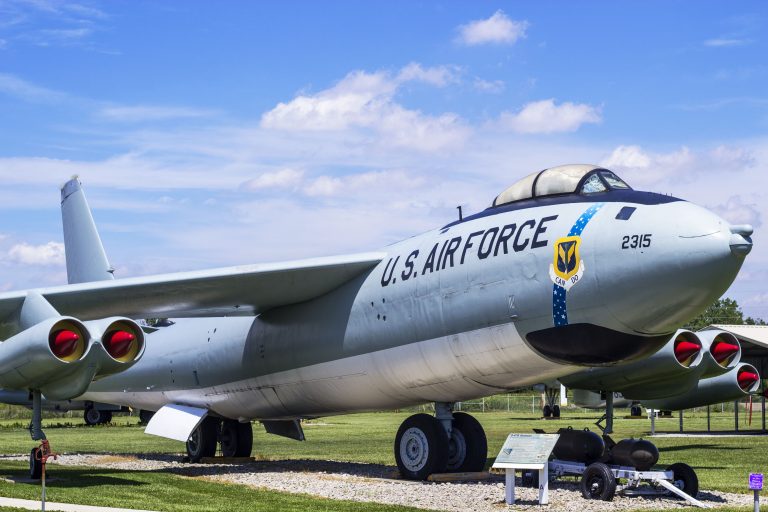
About Our Plane
Tail Number
51-2315
Years in Service
1952 – 1963
Service Location(s)
MacDill AFB | Tampa, FL
Grissom AFB | Peru, IN
The use of the B-47s at Bunker Hill (Grissom) AFB was short lived, first arriving in May 1959, following the arrival of the 305th Bomb Wing just a month prior. These were the exclusive bombers for the wing until the arrival of the B-58 Hustlers two years later in 1961. As the Hustlers arrived, the Stratojets were removed from the base until only a handful were left. Per reports, these were kept explicitly for flight training for existing crews at the base. Tail number 51-2315, a rare B model of the B-47, was part of these early planes and remained in flight until at least 1963.
Just two years after her arrival, 51-2315 was involved in a mid-air incident where one of her engines exploded, taking sixteen (16) feet of wing with it. The explosion occurred during a routine training run with a KC-135 Stratotanker, with the engine and wing portion landing on the ground about thirty (30) miles north of Evansville. Captains John Schwartz and Edwin Waldo were the pilots for the plane along with crew members, 1st Lt James Malaney and Maj. Clyde Jordan. They were able to safely fly the plane back to BHAFB, where investigations were conducted.
Tail number 51-2315 would go on to have at least one more incident, a hard landing, that severely damaged portions of the plane. With the program coming to an end, the decision to retire the plane was made and she was placed on display as part of the base’s historic static exhibition. The plane would remain on base until the entirety of the display was moved to the former base entrance and put under the care of the Grissom Air Museum. Her location at the start of the Air Park’s walkway allows the Stratojet to welcome guests.