A-10A Thunderbolt II
The Warthog
Produced by
Fairchild Republic
Years in Service
1976 – Present
Production Cost
$2.4 million (1965)
[$25.5 million (2026)]
Wing Span
57 ft. 6 in.
Length
53 ft. 4 in.
Height
17 ft. 8 in.
Weight
47,000 lbs
Maximum Speed
450 MPH (Mach .61)
Average Cruising Speed
335 MPH (Mach .47)
Range
2,900 miles
Service Ceiling
44,200 feet
Crewed by
One (1) pilot
Armament(s)
One (1) GAU-8/A 30mm Gatling Gun
16,000 lbs, mixed ordnance
Engines
Two General Electric (GE) TF-34-GE-100 turbofans with 9,000 lbs of thrust (each)
The A-10 Thunderbolt II is one of the most well-known airplanes currently flying today and in our air park, thanks in part to its use in popular media like Call of Duty and its frequent use in combat zones like the Gulf War. Officially named after the famed World War II P-47 Thunderbolt – another close air support plane – most people know it as the “Warthog.”
During the Vietnam War, the U.S. military found themselves in need for a modern replacement for the A-1 Skyraider. Its vulnerabilities (i.e., speed, armaments, etc.) made it a liability where close ground support was needed. Although the F-111 Aardvark and the F-4 Phantom II were created and showed great success during the War as long-range strike & indicator (former) and fighter bomber (latter) planes, they proved to have a short loiter time, poor low-speed performances, and were incredibly expensive to operate. In short, they were terrible for close ground support needs.
The U.S. military chose to rethink their approach, both financially and in design, after the successful introduction of the Bell UH-1 Iroquois and AH-1 Cobra helicopters. An Attack Experimental Program (A-X) was initiated in the 1960s and from this would come the Fairchild Republic’s A-10 Thunderbolt II.
The first flight for the A-10, under the prototype name YA-10, was held on May 10, 1972. The U.S. Air Force was pleased with the design and in the following year, the first planes went into production. The first plane to be fully produced after the order was flown in late 1975 and the first group of planes were sent to the USAF in early 1976. Although having missed service in the Vietnam War, 716 planes were ultimately built until the production was halted in 1984.
The Thunderbolt II’s official name was quickly replaced with the colloquial “Warthog,” an apt description for an unattractive but very durable plane. Its squat shape allows for the A-10 to maneuver at low speeds and altitudes, which coupled with its short take-off and landing capabilities meant the plane was able to be housed close to the front lines.
But shape is only part of what makes the Thunderbolt II so tough. It’s explosion-proof fuel systems, armored body, and the cockpit’s titanium tub protect the plane from direct gun fire (up to 23mm) while it’s 6,000 round per minute 30mm nose gun easily overtakes any ground targets. Additionally, the plane can carry more than its own weight (47,000 lbs) in bombs and ordinances thanks to its eleven pylons.
Furthermore, the plane is designed to still be able to fly with the ‘bare basics’ after an attack, including missing parts of the plane in areas like the tail, wings, or even the engine. Numerous pictures and videos across the internet show an A-10 flying back to base in rough shape. This means that the “Warthog” can have longer loiter times in combat zones and can endure a much larger combat radius in comparison to other airplanes.
As noted, the A-10’s production ended in 1984, however the plane remains in active use, and the USAF has moved to commissioning parts (i.e. wings) to repair and upgrade existing models. There have been at least five attempts to retire the Thunderbolt II, including as recently as 2023, but the lack of appropriate replacement along with its popularity has resulted in the cancelling of these plans every time.
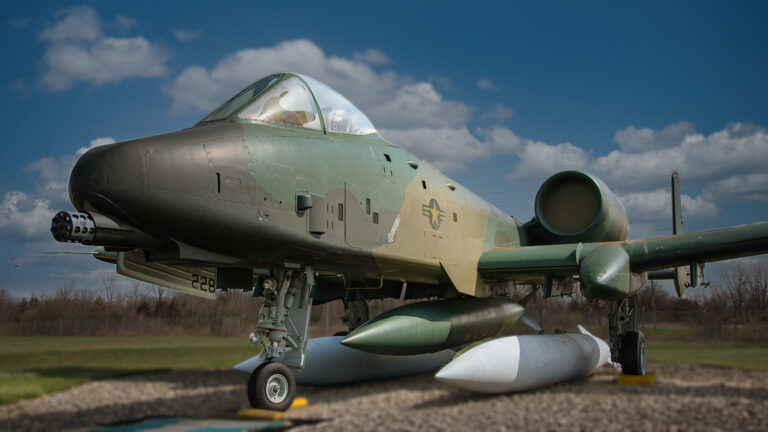
About Our Plane
Tail Number
77-0228
Years in Service
1978 – 1990
Service Location(s)
Grissom AFB | Peru, IN
RAF Woodbridge | Ipswich, Suffolk, England
A-10 Thunderbolt II with the tail number 77-0228 has a long history here in Indiana, having been flown by the 45th Tactical Fighter Wing/ Fighter Squadron when they were stationed at Grissom Air Force Base.
The 45th had been originally activated in 1944 and two additional times (1952 and 1962) before they were reactivated in 1973 as part of the Air Force Reserves (AFRES). In this new era, they were assigned first to the 434th Tactical Fighter Wing and then to the 930th Tactical Fighter Group.
Although it would take almost ten years for all the A-10’s to arrive at Grissom AFB, Tail No. 77-0228 arrived in 1978, among the very first. For a brief period in the early 1980s, she was stationed at Royal Air Force Base (RAF) Woodbridge, located in Ipswich, Suffolk, England. While there is not much information about her time overseas, records show her back in Indiana by the middle of the decade.
Tail No. 77-0228 would remain in service with the 45th Fighter Squadron until it was decommissioned by the AFRES in 1990. The plane was demilitarized and moved to the newly established Grissom Air Museum.