F-100C Super Sabre
The Hun
Produced by
North American Aviation
Years in Service
1954 – 1988
Production Cost
$664,000 (1954)
[$8.2 million (2026)]
Number Produced
2,294
Wing Span
38 ft. 10 in.
Length
53 ft. 11 in. (with boom extension)
47 ft. 0 in. (with boom folded)
Height
15 ft. 6 in.
Weight
36,549 lbs
Maximum Speed
900 MPH (Mach 1.72)
Average Cruising Speed
600 MPH (Mach .78)
Range
1,350 miles
Service Ceiling
51,000 feet
Crewed by
One (1) pilot
Armament(s)
Four M39 20mm cannons
42 2.75-inch rockets or 5,000 lbs. of bombs
Engine
One Pratt & Whitney J57 of 16,000 lbs. thrust with afterburner
Flown By
U.S Air Force | Royal Danish Air Force | French Air Force | Republic of China Air Force | Turkish Air Force
The F-100 Super Sabre represents the first of the famed Century Series – six planes that ushered in the age of the supersonic jet. The success of these planes reshaped military aviation and became key players both in combat and in the work to keep peace in the age of nuclear threats.
As early as the 1940s, companies like North American Aviation (NAA) were experimenting with the new jet propulsion technology and eventually developed what was dubbed the Sabre 45. Inspired by the F-86 Sabre, the plane’s 45 degree swept wing design rounded out the prototype’s name.
In a bit of a gamble, NAA sent the US Air Force a proposal for the Sabre 45 in 1951. Although unsolicited, the USAF nonetheless were interested in the possibilities the plane provided. Internal discussions set a deadline for a fully operational plane by 1957, with a preferred deadline of 1955. Interestingly, leadership opted to place a quantified order with NAA despite no actual flight tests being conducted.
Because NAA was also producing F-86 Sabres for the military during the Korean War, the focus on the renamed F-100 slowed down. But by 1953, the conflict was winding down, and NAA returned its focus to the Super Sabre’s production. In May of that year, famed test pilot George Welch was selected to conduct the plane’s first test flight. Upon leveling out at 35,000 feet, he was directed to let the plane reach its full speed and became the first pilot to fly at Mach 1 in level flight in a jet. He ultimately topped out at Mach 1.05, which surprised testers as the F-100 had been outfitted with a Pratt & Whitney XJ57-P-7 engine that was experiencing decreased output.
Testing revealed several flaws despite the over 100 modifications to the plane’s original design prior to the prototype’s construction. Two of the more well-known flaws were yaw (side-to-side motion) instability, and inertia coupling that would lead to the plane unexpectedly roll in mid-flight. Modifications and testing continued well into 1954, even as planes were being produced for the USAF to be entered into service.
Despite this rocky start, the F-100 proved to be a capable plane and during its use by both American and allied militaries, nineteen (19) variants were produced. As with many planes, not every variant was produced at full scale, and some were only available with certain militaries (i.e. French Air Force). Its primary use was as a fighter-interceptor, but reconnaissance, drone, and trainer versions were also produced.
The Super Sabre’s combat history is almost exclusively tied to the Vietnam War, but versions were used by the French during the Algerian War and by Turkey during the 1974 Invasion of Cyprus. Of all the planes used during the Vietnam War, the F-100 was the longest serving (1961 – 1971) before being phased out in favor of other planes, such as the F-4 Phantom II and the F-105 Thunderchief. Nearly 250 Super Sabres were lost, but the entire fleet flew a combined 360,283 sorties throughout the war. No credited aerial victories were logged by the Super Sabres that time.
The F-100 also served as the second plane used by the USAF’s Thunderbirds demonstration team. Flown for a combined eleven years, the Super Sabre is the second most used plane in the history of the team, following their current roster of F-16 Falcons. The C-model was used between 1956 and 1963 and after a disastrous turn with the F-105 Thunderchief, the team switched to the F-100D and flew them from 1964 to 1968.
The plane would remain in use by the USAF and the Air National Guard until it was retired in 1979. Both Grissom AFB and the Fort Wayne Air National Guard flew the Super Sabres at various times, including towards the end of the plane’s run. The Republic of China would continue using them until they were phased out in 1988. Today, many of the remaining are on display at museums and municipal locations like veteran parks. Nearly two dozen can be seen in seven other countries such as the Netherlands and Taiwan. It’s been reported that at least two are still airworthy.
As the first of the Century Series, the F-100 Super Sabre set several flight records, including winning the Bendix Trophy in 1955. Among these are:
- August 1955: Set the supersonic speed record at 855 MPH
- December 1956: Two F-100Ds were the first planes to complete buddy refueling
- August 1959: Two F-100Fs became the first jet planes to fly over the North Pole
While many of the speed records set by the F-100 during the 1950s were broke by later models, its precedence made those future record breakers possible.
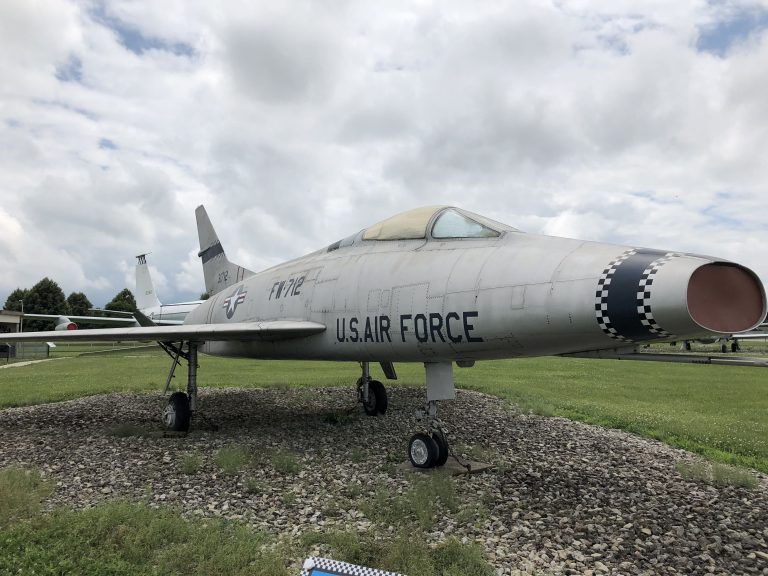
About Our Plane
Tail Number
53-1712
Years in Service
1955 – 1956
Service Location(s)
NAMIC (Air Materiel Command) | Inglewood, CA
Edwards AFB | Edwards, CA
National Advisory Committee on Aeronautics | California
F-100 Super Saber, tail number 53-1712, did not have a long history, but it was a memorable and groundbreaking one. Unlike other F-100Cs, this plane was sent directly to the U.S. Air Force for testing and research. Her first stop was the Air Materiel Command units stationed at Inglewood, California, where the designation was changed from F-100C-1-NA to JF-100C.
The Super Sabre was transferred out in September of 1956 to the 6515th Test Squadron at Edwards AFB (CA), where it was used as an evaluator plane for the National Advisory Committee for Aeronautics. As the precursor to NASA, the work being completed by NACA was important to the development of aviation technology throughout World War II and into the early decades of the Cold War.
53-1712 was used in thirty test flights, which focused on the effects of a pitching motion damper on supersonic planes like the F-100. The tests took place between September 1956 and March 1957 and four pilots participated in the tests.
Sixteen of those were undertaken by famed research pilot Stanley Butchart (1922 – 2007), who had been flying for NACA since 1951 and would rise to chief pilot by the time of his retirement from the program in 1966.
Future first man on the moon Neil Armstrong (1930 – 2012) was the pilot on ten of those test flights and was given the honor of flying 53-1712 to her next location at the Military Aircraft Storage and Disposal Center in Tucson, AZ. Armstrong had only been a pilot with NACA for a little over a year when he took part in these tests. During his career, he worked as a project pilot on several of the Century Series flyers. The F-100C Super Sabre was only one of 200 planes he would ultimately fly as a tester.
The last four flights were split between World War II veterans Capt. Joseph Walker (3) and Capt. Hugh Hunerwadel (1). Both perished during test flights for the NACA. Hunerwadel died in September 1958 while testing a U-2 weather reconnaissance plane near Rodgers Dry Lake in California and Walker perished in June 1966 when his F-104 Starfighter clipped an XB-70 Valkyrie during a promotional photo shoot. One of the two pilots in the Valkyrie also perished in the crash.
53-1712 did not remain in the MASDC ‘boneyard’ for very long and spent three years being used at Norton, McClellan, and Langly AFB before being returned to MASDC. It would be pulled from storage in 1971 by the National Museum of the U.S. Air Force and added to their loan program. The F-100 spent seven years on static display at Lackland AFB’s Parade Ground Air Park. It wouldn’t be until 1986 when the plane was then loaned to Grissom AFB and its whereabouts in those interim years are unknown.
Grissom AFB maintained 53-1712 until stewardship was transferred to the GAM in the early 1990s and was part of the first planes in our air park.