F-4 Phantom II
World's Leading Distributor of MiG Parts
Produced by
McDonnell Aircraft Corporation
(McDonnell Douglas Corporation)
Years in Service
1960 to present
Production Cost
$1,898,365 (1960)
[$21.6 million (2026)]
Number Produced
5,195
Wing Span
38 ft. 5 in.
27 ft. 6 in. (folded)
Length
58 ft. 2 in.
Height
16 ft. 6 in.
Weight
58,000 lbs (loaded)
Maximum Speed
1,400 MPH (Mach 1.82)
Average Cruising Speed
590 MPH (Mach .77)
Range
1,750 miles
Service Ceiling
59,600 feet
Crewed by
Two (2)
Pilot & Weapons & System Operator (USAF)
Pilot & Radar Intercept Operator (USN)
Armament(s)
Up to 16,000 lbs external munitions
20mm cannon pods
Engine
Two General Electric J-79-GE-15s with 17,000 lbs thrust each (w/ afterburners)
Flown By
Currently: Hellenic Air Force | Islamic Republic of Iran Air Force | Turkish Air Force
Formerly: US Air Force | US Navy | US Marine Corps | NASA | Royal Australian Air Force | Egyptian Air Force | German Air Force | Israeli Air Force | Iranian Royal Air Force | Japanese Air Self Defense Force | Republic of Korea Air Force | Spanish Air Force | Royal Air Force
Other Known Nicknames
Snoopy | Rhino | Double Ugly | Old Smokey | The Flying Anvil
Flying Footlocker | Flying Brick | Lead Sled | The Big Iron Sled | St. Louis Slugger
The F-4 Phantom II is one of the more popular planes among military aviation enthusiasts and with over 5,000 produced, there are plenty of former pilots and crewmen who have fond memories of the “lead sled.”
As with the F-100 Super Sabre, the Phantom began has a side project by its creator, McConnell Aircraft Corporation with the intention of pitching the plane to the U.S. government. After some investigating, it was deemed the U.S. Navy was the most likely branch to need an updated plane.
Recognizing that the biggest gap in the USN fleet was an attack fighter, MAC looked to its F3H Demon, a naval fighter the company produced just two years prior. After making some modifications to the plane, including the engine types that could produce up to Mach 1.9 speeds, the USN was approached by the company. While agreeing with MAC about the need for that attack fighter, the USN returned to the company with a series of changes they wanted to see in the design.
Although pleased with the updated design, the USN realized that planes in the queue at companies like MAC and in their own fleet met most of the branch’s needs. Therefore, another round of design requests were made. By this point, the Navy had narrowed down their need to a fleet defense interceptor and requested for the new design to include space for a second pilot who would handle the radar.
Although in competition with the XF8U-3 Crusader III (produced by Chance Vought), the now designated F-4 was ultimately chosen by the USN. Among the possible code names were Mithras and Satan, but the company settled on Phantom II (after FH-1 Phantom). Until the code and name were unified by the Tri-service designation system, the US Air Force used the name F-110A Spectre.
It would be Fighter Squadron 121 (VF-121), known as the Peacemakers, who would be the first to fly the Phantom II and VF-74 (the Bedevilers) became the first squadron to be deployed, spending time on the U.S.S. Forrestal. It should be noted that these early Phantoms were not in combat in Vietnam but would find themselves in the thick of battle by 1964.
The Phantoms would remain a key part of aerial combat during the Vietnam War and would be used from those early years through the final days of combat in the 1970s. Unlike the USN, the US Marine Corps and the US Air Force would engage their F-4 fleets in 1962 and 1965, respectively. At least five variants of the F-4 were produced and used during the war across all three branches.
During its production, nearly two dozen variants of the Phantom were produced, including those designed specifically for foreign militaries. Along with the three American branches, the Phantom II was used by the air forces of Australia, Egypt, Germany, Israel, Japan, South Korea, Spain, and the U.K. Even NASA flew the F-4s in the 1960s and the 1980s!
The final plane to be built was in 1981 and within a few years, the Phantoms were slowly phased out of service. Most would be retired in the 1990s, but many were still in use well into the 21st century. The USAF was the last among the American branches to fly these planes, retiring them in 2016 as missile drones. Others like Japan and Egypt flew until them until 2020. Three Air Forces still fly F-4s – Greece, the Iranian Islamic Republic, and Turkey.
About Spook
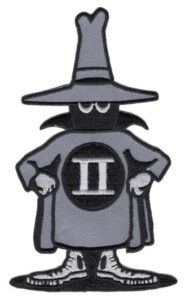
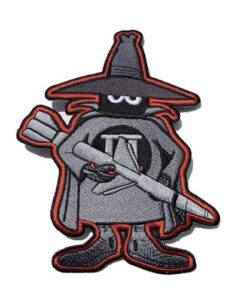
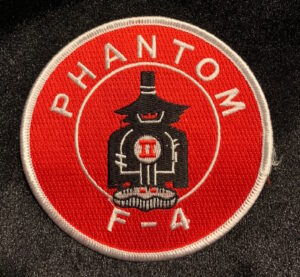
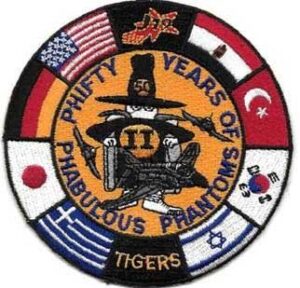
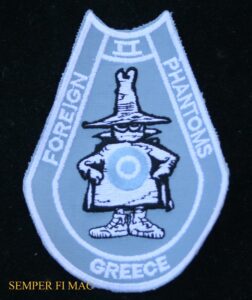
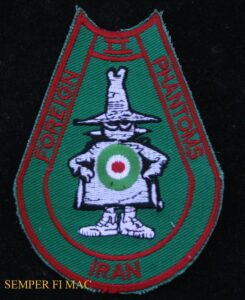
In a rare turn of events, the F-4 Phantom II’s mascot was designed by one of McConnell Douglas’ own artists rather than something created by a member of the military. Anthony Wong’s design features a mysterious figure in a hat and trenchcoat, with only its eyes, hands, and boot-clad feet visible. The illustration’s first reported use was in 1958 and certainly is reminiscent of mid-century animation from companies like Hanna-Barbera.
Although Wong was the designer, he did not give a name to his creation. Instead, it’s generally agreed upon that the name “Spook” (or “Spooky”) came from MacDill AFB in Florida, however debate over which wing named him remains. Depending on the version being told, it was members of either the 12th Tactical Fighter Wing or the 4453rd Combat Crew Training Wing.
He is a popular mascot and one of the most recognizable. Official and unofficial versions of Spook exist, both in variations of his costume as well as his coloring. It seems that most of the changes made to the design focus on his chest medallion. While usually sporting the “II” for Phantom II, versions have included other numbers, letters, and even flags. Not all designs or uses of Spooky align with military code and may be privately produced for fans or veterans of the F-4.
About Our Plane
Tail Number
64-0783
Years in Service
1965 – 1987
Service Location(s)
Davis Monthan AFB | Tucson, AZ
Da Nang Air Base | Da Nang, South Vietnam
Phan Rang Air Base | Phan Rang, South Vietnam
Eglin AFB | Valparaiso, FL
Udorn Royal Thai Air Force Base | Udorn Thani, Thailand
Naval Station Joint Reserve Base | New Orleans, LA
Luke AFB | Glendale, AZ
Hulman Field | Terre Haute, IN
March AFB | Riverside, CA
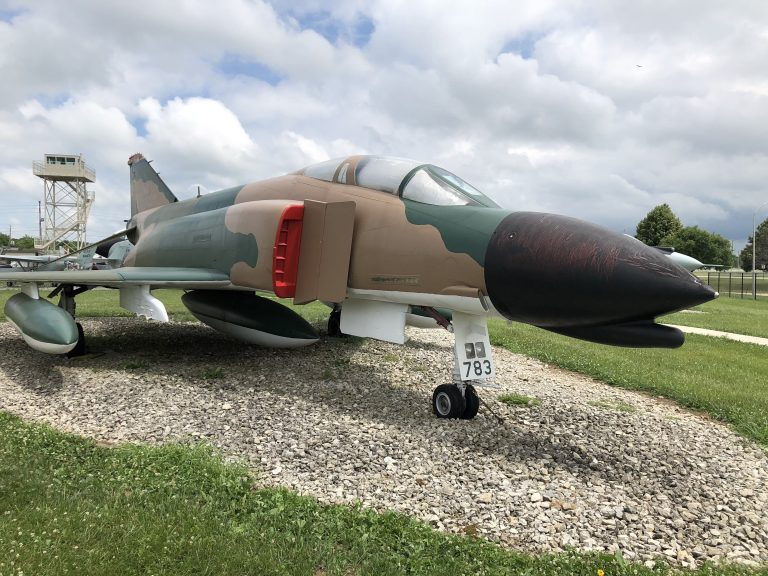
The F-4C Phantom II with Tail No. 64-0783 has been part of the Grissom Air Museum’s collections since 1987 but prior to its arrival, it’s service history took it literally around the world.
First built in mid-1965, our F-4 was only stateside for about four months before being sent overseas to Vietnam. Between January 1966 and 1970, the plane was stationed first at Da Nang Air Base before being sent to Phan Rang Air Base. It was assigned to the 35th Tactical Fighter Wing for the entirety of the conflict. Along with the F-4s, the wing also flew the B-57 Canberra and F-102 Delta Dagger.
The 35th TFW spent most of their time in Vietnam handling air support (close and direct), interdiction, reconnaissance (visual and armed), photography, escorting, and rapid action alert. Towards the end of the wing’s time in the conflict, they were used to support South Vietnamese actions in Cambodia and Laos. Detailed information about Tail No. 64-0783’s service in Vietnam is currently unavailable.
For whatever reason, Tail No. 64-0783 was sent back stateside for about a year and was assigned to the 58th Tactical Fighter Wing at Eglin AFB in Florida. By the summer of 1972, the entire wing was sent to Udorn Royal Thai Air Force Base in Thailand as part of the Summer Help Program. The wing and plane would remain in Thailand until recalled to the states in 1979. As with its first stint in Southeast Asia, direct information about its use during this time is unavailable.
Upon its return to the U.S., this F-4 was assigned to the 122nd Tactical Fighter Squadron at the New Orleans Joint Reserve Base and stayed in service with them until very late 1981. Its reassignment to the 426th Tactical Fighter Training Squadron at Luke lasted about four years but it’s uncertain whether it was used as a trainer or not.
It would make its way to Indiana in 1986 when it was sent to the 113th Tactical Fighter Squadron stationed at Hulman Field in Terre Haute. This transfer lasted for about a year before the plane was then sent to the 196th Tactical Fighter Squadron at March AFB in California.
By 1987, Tail No. 64-0783 reached the end of its life as an active service plane and would be handed over to the National Museum of the Air Force in Ohio. It would become part of its airplane loan program and be sent directly to Grissom AFB, where it has been under the care of the GAM ever since.