F-11A Tiger
[Formerly F-11F-1]
Produced by
Grumman Aircraft Engineering Corporation
(Grumman Aerospace Corporation)
Years in Service
1956 – 1969
Production Cost
Unknown
Number Produced
199 (estimated)
Wing Span
31 ft. 5=7 in.
Length
46 ft. 11 in.
Height
13 ft. 3 in.
Weight
14,330 lbs
Maximum Speed
753 MPH (Mach .98)
Average Cruising Speed
578 MPH (Mach .75)
Range
1,275 miles
Service Ceiling
41,900 feet
Crewed by
One (1) pilot
Armament(s)
Four (4) 20mm Colt MK 12 cannons
Four (4) hardpoints (external load carriers)
Engine
One Wright J65-W-18 with 10,500 lbs thrust (w/ afterburners)
Flown By
US Navy
Other Known Nicknames
None
As America entered the jet-age in the early years of the Cold War, the U.S. Navy, along with the U.S. Air Force, raced the Soviets to expand their jet plane arsenal. Among the new supersonic aircraft under the Navy’s ownership was the F-11 Tiger.
Developed by Grumman Aircraft Engineering Corporation in 1952, the future Tiger began its existence as an internal design study. The F9F-6 Cougar was already in service with the Navy, but designers at Grumman felt it could be improved upon. The design was coded G-98, and it caught the eye of the Navy, who ordered two prototypes. Taking its code from the Cougar, the XF9F-8s flew in 1954. While the first version nearly reached Mach 1, the second one became the first Navy plane to break the speed of sound.
Further testing and design refinements would improve the XF9F-8 design, so much so that it succeeded in being the first jet plane to shoot itself. Test pilot Tom Attridge likely didn’t intend to make history in September 1956, but during a routine testing run, he did. That particular flight was the second of the day and completely focused on testing the plane’s cannons.
Attridge was directed to take the plane to 22,000 feet and speed up in afterburner at a 20* angle past Mach 1. At 13,000 feet, it was planned for him to fire the cannon in four second bursts with a three second pause to allow for cooling, with the second burst coming at 7,000 feet. Afterwards, he would expend the ammunition load and continue the flight.
What was not planned was the plane overtaking the expended ammunition. At least three 20mm rounds hit the plane – one each in the windscreen, the right intake lip, and the nose cone. The damage to the plane caused Attridge to pull back on speed, dropping the engine power to 78%. Attempts to go faster cause the plane to become difficult and eventually caused him to lose power as he came within sight of the runway.
As the plane began to land, it descended into the treetop before hitting the runway and going another 300 feet before stopping. Attridge was taken to the local hospital, where he was treated for sustained injuries and the plane, which caught fire, was recovered.
It was believed that as Attridge shot the first burst, he was in descent and flew under the trajectory of the munitions. When he pulled out of the descent at 7,000 feet (or 11 seconds later) he flew directly into the line of fire. Further investigation showed that he also nicked the plane during the first test run with the cannons earlier in the day but somehow managed to not hit the plane directly.
Despite this, the Navy liked the look, design, and speed of the plane. Renamed the F-11F Tiger (and F-11 Tiger after 1962), the first planes delivered were sent into service in 1956. By 1959, the last of the 199 built were in use.
At least seven Navy squadrons flew the F-11s, both in the Atlantic and Pacific fleets. Their small size made them perfect for carriers, with only a few inches of wing needing to be folded up. But once in action, the promise of the Tiger started to fade. Despite its Mach 1 speed, the plane was unable to sustain it in the long-term, especially in comparison to the Vought F-8 Crusader. Further issues with the J65 engine and its increasingly poor range, grounded the Tiger as a combat plane.
Instead, these planes found themselves in use as trainers for Naval aviators stationed with NAS locations in South Texas. The plane was meant to provide students with a first introduction to supersonic flight and its short use of the speed made it easy for young aviators to become acclimated to these faster speeds.
Several planes were given to the Blue Angels, the Navy’s air demonstration team. This would be one of the longest serving planes for the team, used between 1957 and 1969. Although most noted for the use of the F-18 Hornet, the Tiger is one of their more memorable planes due to its sleek design and afterburner.
Eventually all the known F-11s were taken out of service and remained in storage until 1973, when two former Blue Angle F-11As were used by Grumman. Testing on various engines and afterburners would continue until 1975. The planes were returned to storage and today, they remain the last Tigers to fly.
Due to its short run, there are only five variants of the Tiger, including its prototype. Outside of those two and the 199 F-11F-1s built, all remaining planned versions were cancelled. Twenty planes are currently on display, including the one here at Grissom.
About the Blue Angels
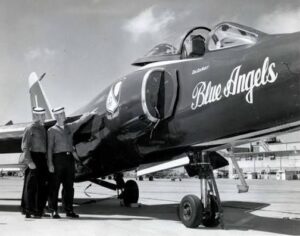
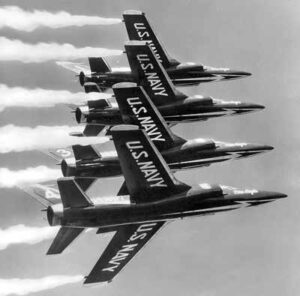
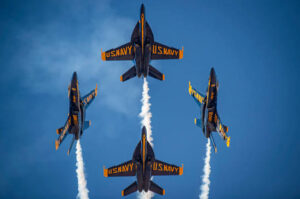
The Blue Angels, like their Thunderbird counterparts, are considered the best pilots in the world. Established in 1946, they are the second oldest aerial demonstration team in the world. First known as the Navy Flight Exhibition Team, a chance advertisement for the Blue Angel night club in New York City inspired the use of the name for the team. The former name was only used for three months before the change.
The insignia’s basic design has been in use since 1949 and while originally a very dark navy blue and gold, the colors lightened by the time the team introduced the Panthers to the line-up. The overall design has not been modified since then, with the exception of the plane silhouettes, which are changed when a new plane is put into service.
The earliest planes used were the F6F Hellcat and F8F Bearcat before the F9F-2 Panther – the team’s first jet plane – was introduced. Subsequent planes included the F-9 Cougar, the F-11 Tiger, the F-4 Phantom II, and the A-4 Skyhawk. The introduction of the F/A-18 Hornet (and later Super Hornet) in 1986 has made this plane the longest serving of any aircraft in either demonstration team. There are no plans currently to replace the F-18 Hornets.
The Hornets are modified for show use (i.e. removal of weapons) but can be reconfigured to combat status within seventy-two hours if needed. All but Pilot 7 (the narrator) flies single seat plane and No. 7’s two-seater is used for demonstration rides, although if a second two-seater can be brought in, No. 4 will fly that version and carry other military members. Currently a Lockheed C-130 Hercules is used for supply and personnel transport.
The current team consists of seven pilots – six from the U.S. Navy and one from the U.S. Marine Corps – that perform at least sixty shows every season. Both flight and personnel teams are rotated out every two to four years, depending on the position. Unlike the Thunderbirds, pilots will be rotated among positions, such as #7 (narrator) to #6 position (opposing solo) for a year before moving to #5 position (lead solo) for two years. Position #1 is the commanding officer and is always a Naval officer.
Given the age of the Blue Angels, it’s no surprise that several World War II aces would be tapped to perform in the early years of the team. Capt. Roy Voris, Edward Freightner, and Arthur Ray Hawkins had been decorated pilots during the war and helped to shape those early years. Donnie Cochran was the first Black man to fly with the Blue Angels (1986) and served as its commander. Katie Higgin Cook (2015) and Amanda Lee (2022) were the first women to fly with the Blue Angels. Cook flew the C-130 Hercules transport plane, which also performs in the show, and Lee would be the first women demonstration pilot sitting in the F-18.
About Our Plane
Tail Number
141790
Years in Service
1959 – 1969
Service Location(s)
USS Bon Homme Richard
Davis Monthan AFB | Tucson, AZ
NAS Pensacola | Florida
NAS Glynco | Georgia
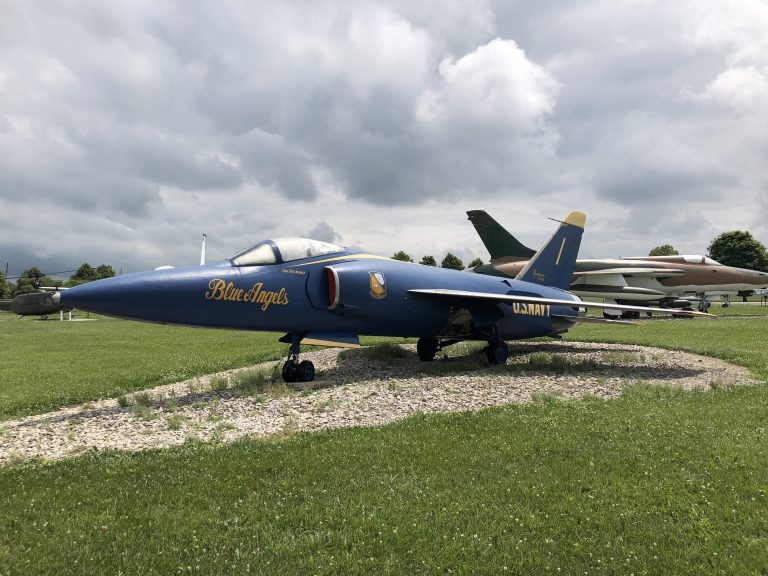
F-11 Tiger, tail no. 141790, arrived at the Grissom Air Museum in 1998, making it among the earliest planes to come under the museum’s care after the air park was established in 1991. Although the construction year is unknown, it’s service entrance of 1959 indicates its one of the last planes to be built by Grumman before the cancellation.
Upon entering service, it was assigned to the USS Bon Homme Richard, where it was flown by members of the VF-191 Fighter Squadron. It would remain with the squadron until 1961 when it was sent to Davis-Monthan AFB for storage. While in storage, its designation was changed to F-11A in 1962 when the military unified its naming and designation codes.
In 1964, it would be pulled from storage and transferred to NAS Pensacola, where it was assigned to the Blue Angels. Marked at Plane 2, it only flew during the 1965 season but remained with the team until 1966.
The following year it would be transferred to NAS Glynco in Georgia, but there is little information as to its use during that time. It is likely it could have been used for training purposes as its history shows it use until struck off the list in 1969. Put in the care of the National Naval Aviation Museum, it would remain at NAS Glynco as a static display until 1991. It would spend seven years at the Florence Air and Missile Museum in South Carolina before making its way to Peru in the summer of 1998.
It should be noted that at all three locations, Tail no. 141790 retained its Blue Angels livery and color scheme. Despite having three planes associated with the Thunderbirds, the F-11 Tiger remains the GAM’s only plane to serve on an aerial demonstration team.